Showing posts with label Advanced Manufacturing. Show all posts

Monday, January 1, 2018

Is there anything on the horizon that will challenge the dominance of smartphones?

I was born in the late sixties in India. In the early seventies, our home had only a few appliances that used electricity – a couple of fans, few light bulbs, and a radio. As the middle class in India started catching up to the western standards of living, by late nineties my family in India had acquired televisions, video cassette players, audio cassette players, refrigerators, phones, washing machines, food processors, evaporative coolers, water heaters, etc. Our family was not an early adaptor of technology. By the time my family was ready to buy a new gadget, there were at least another hundred million families in developing economies that were acquiring the same gadget. Each new gadget had a market size of few tens of billions of US dollars and its wide-scale adoption added hundreds of thousands of jobs to the manufacturing sector worldwide. The growth in the sale of the manufactured products was a proven strategy to grow the economy.
 
I came to the US in nineteen ninety. We acquired a large number of electronic gadgets over the twenty year period including camcorders, digital cameras, navigation systems, cell phones, personal digital assistants, voice recorders, CD players, MP3 Players, handheld game consoles, alarm clocks, digital wrist watches, pedometers, televisions, DVD players, cordless phones, etc. Every year there was a new and exciting electronic gadget on the market that was on our wish list. The list of must-have products was growing and new hardware companies were springing everywhere to offer new products. Middle-class consumers have been fueling the economic growth and raising the standards of living for people through expansion of the global manufacturing sector.
 
The consumer electronic landscape started changing with the arrival of iPhone in 2007. My wife was an early adopter. She was using her iPhone to play music and get driving directions. She did not need her navigation system or her MP3 player. Soon the camera on her upgraded iPhone was quite decent and she abandoned her digital camera. Her wrist watch and the alarm clock on her nightstand were the next items to disappear.
 
Products made obsolete by smartphones (Cordless Phone Image Source: https://www.vtechphones.com/; Pedometer Image Source: https://www.amazon.com/; Digital Alarm Clock Image Source: https://www.amazon.com/; Hand held Game Consoles Image Source: https://www.forbes.com/; MP3 Players Image Source: http://www.ebay.com/; GPS Navigation System Image Source: http://www.navigadget.com; Digital Camera Image Source: https://www.bestbuy.com; Camcorder Image Source: https://www.bhphotovideo.com/; Electronic Voice Recorder Image Source https://www.amazon.com/; Personal Digital Assistant Image Source: http://itsolutiontest.blogspot.com/; Scanner Image Source: https://www.amazon.com/; Radio Image Source: https://www.amazon.com)


The list of products impacted by smartphones includes: (1) digital cameras, (2) video cameras, (3) navigation systems, (4) personal digital assistants, (5) MP3 Players, (6) voice recorders, (7) handheld game consoles, (8) alarm clocks, (9) pedometers, (10) cordless phones, (11) radio, and (12) scanners. Some people are also using smartphones as calculators, barcode readers, searchlights, mirrors, remote controls, keys, translators, wallets, and paperweights. All signs indicate that smartphones will make many more products vanish from the market over the next few years. Recent media reports are touting the ability of smartphones to function as metal detectors, digital projectors, and mosquito repellents! This phenomenon has never been seen before. Usually, a new product made a product with similar functionality obsolete. For example, DVD players made video cassette players obsolete. Smartphones are simply absorbing the functionality found in other products and altering the consumer electronic product landscape.
 
So far large screen TVs, high-quality headphones, and health monitoring systems (e.g., fit bits) appear to be immune from smartphones’ takeover. As I am writing this blog post, I am realizing that with the exception of a TV, a couple of headphones, and few fit bits, we have not bought any new electronic gadget in the last three years. Every few weeks, we get excited about new apps for our smartphones and we are constantly discussing which smartphone to get next. However, we are simply not keeping up with our previous pace of consumer-electronic hardware purchase. Smartphones have altered consumer behaviors and expectations and have ushered in the era of the app-based economy. 

Cars and homes depicted in sci-fi movies have not yet materialized. However, smartphones have fundamentally changed the way humans communicate, commute, shop, and bank. They have also opened up new channels for news delivery, advertisement and entertainment. Many people are now attached to their smartphones and cannot imagine life without them. The fear of not being to check one’s smartphone is now a recognized phobia. Twenty-four seven connectivity makes is difficult for people to disengage from work and induces a high level of stress. Smartphones are being blamed to cause several different kinds of sleep disorders. Smartphones have had the biggest impact on daily lives of humans since the advent of personal computers and fundamentally changed the cultural norms and human behaviors.

A reasonably good quality smartphone costs between $500 and $1000. Most people look forward to upgrading their smartphones to newer models in two (or fewer) years. Many previous electronic products such as digital cameras were shared by members of the family. Smartphones are not meant to be shared. Everyone needs to have their own smartphone. This is fueling growth in smartphone sale. Annual smartphone sales volume has already crossed the one billion mark. Soon revenues generated from smartphone sale will be more than one trillion US dollars. Smartphones have fundamentally altered the consumer electronics landscape and had a profound impact on the industry. Most high technology companies want to a part of this action and are launching their own smartphones. If this trend were to continue and the popularity of ride-sharing apps slow down the sale of automobiles, then smartphones might take over the automotive industry in terms of worldwide sales revenues. Smartphones currently appear indispensable and imagining life without them is not possible.
 
Heraclitus, a Greek philosopher said that change is the only constant in our lives. I am sure that dominance of smartphones (at least in the current form) won’t last forever. I am beginning to wonder what will replace smartphones. With easy access to the cloud, we don’t need to do any serious computing on the handheld devices. Miniaturizing is creating powerful sensors that can be easily integrated into other items carried by people. The key innovation offered by smartphones was the touchscreen-based user interface. The next generation brain-machine interfaces might reduce reliance on touchscreen interfaces. If augmented reality-based glasses become popular and everyone starts wearing them, then it will be easy to simply add smartphone functionalities to them. They will certainly provide a better display and sound quality than smartphones. People have been talking about smart clothing for a while. Would smartphones survive in the current form if smart clothing idea takes off?
 
Is there anything on the horizon that will challenge the dominance of smartphones?

Thursday, July 6, 2017

2017 NIST Agile Robotics for Industrial Automation Competition (ARIAC)

This year NIST organized a simulation based competition called Agile Robotics for Industrial Automation Competition (ARIAC). The idea was to move away from traditional robots that execute preprogrammed motion. Teams were challenged to build a system that can dynamically respond to failures in grasping, defective parts, and priority orders. Teams were expected to do this by using the minimum number of sensors. The task in the competition was focused on building assembly kits. The robot had to pick parts from bins and a conveyor and place them on automated guided vehicles.

Please see https://www.nist.gov/news-events/news/2016/01/nist-launches-international-competition-make-robots-more-agile for details on this competition.

My group fielded a team in ARIAC. Team members included Matt Buckley and Brual Shah. Competition results were announced on July 5, 2017. Please see https://www.osrfoundation.org/ariac-finals-results-announced/ for details. I am happy to report that our team won the competition.

You can check out our
competition entry in the video shown below.


Tuesday, June 27, 2017

KUKA Innovation Award 2017

My group at the University of Southern California fielded a team in KUKA Innovation Award 2017 competition. Team members included Ariyan Kabir, Sarah Al-Hussaini, Abdullah Alsharhan, Vivek Annem, Iain Brookshaw, Qi Deng, Alec Kanyuck, Nithyananda Kumbla, Joshua Langsfeld, Rishi Malhan, Fadel Muci, Brual Shah, and Shantanu Thakar. 


After two preliminary rounds, our team was selected as one of the five finalists. Applicants for this award were expected to demonstrate an innovative robotic application using Kuka iiwa arms. Our team traveled to Hannover Messe in Germany to showcase our entry in the competition. This is one of the largest trade fair in the world. Usually, more than 250,000 visitors attend this trade fair. Distinguished visitors this year included Angela Merkel, Chancellor of Germany.

The focus of our application was automation of finishing processes such as grinding, sanding, and polishing. We combined planning, control, perception, learning, and augmented reality technologies to create a new robotic system for finishing operations. Our setup used two robots. The first robot held the part and the second robot manipulated the cleaning tool. We used external sensors to monitor the task progress.

Our application was significantly different from the traditional robotic applications in manufacturing. Robots in traditional manufacturing operations use pre-programmed motions to carry out the tasks. This idea only works when a robot is used is mass production application to make the same part over and over and this approach does not help in low volume production. An example of this is post-processing operations in additive manufacturing of custom parts. For metal based 3D printing, surface finishing operations are still manual and can take a very long time.

Angela Merkel, Chancellor of Germany walked past our booth (Image Source: Kuka)
Visitors at our Booth (Image Source: USC CAM)
Our Booth at Hannover Messe (Image Source: Kuka)

Picture at Awards Ceremony (Image Source: Kuka)

Our team with the Finalist Trophy (Image Source: USC CAM)

Manual surface finishing tasks are very tedious and time consuming and contribute significantly to the total cost in manufacturing. They also pose risks to the health of the workers. Our team believed that robots should do the tedious labor and humans should perform high level decision making in surface finishing operations. This way, we can increase the productivity of human operators and improve their quality of life.

The automated finishing system needed to manage the interaction between robots, tools, and the part to be finished. Robots needed to learn and optimize parameters on-the-fly for any given object and plan their moves. A perception system was also required for detection and localization, assessing surface quality, and ensuring safety. To achieve these goals, we integrated new planning and learning algorithms with the existing technology for perception and control.

Overall we received a lot of positive feedback on our demonstration. Many companies were interested in deploying our technology. Our team returned back to USC with a resolve to mature the technology and get it ready for deployment.

Sunday, November 13, 2016

Latest manufacturing advances create new vulnerability to cyber threats

A number of recent reports have pointed out the vulnerability of manufacturers to cyber threats. Small manufacturers are an important part of the manufacturing supply chain and simply do not have expertise and resources to take proactive preventive actions against sophisticated cyber threats. These vulnerabilities can be exploited to cause disruptions to the supply chain. 

The introduction of advanced manufacturing technologies is expected to revolutionize manufacturing, enable innovation, and create new businesses. However, emerging manufacturing technologies will create new vulnerabilities from the cyberattack perspective. Here are representative examples of vulnerabilities created by the introduction of new manufacturing technologies.
  • Digital Manufacturing: The manufacturing sector has moved away from paper–based blueprints and has embraced digital models. 3D models are being used to manage design and manufacturing processes and speed up the product development process. However, the reliance on digital data and models creates new vulnerabilities during cyberattacks.
  • Network-Connected Machines: The Internet of the Things is revolutionizing manufacturing by finding applications in prognostics and health management, on-line process monitoring, and process optimization. It is expected to increase manufacturing resource availability, reduce energy and water consumption, and fundamentally alter the ways manufacturing equipment gets maintained and serviced. However, a machine connected on the Internet can be a target for a hacker.
  • Cloud-Based Services: Cloud based services are increasingly being used to exploit big data related technologies to make sense of the data being generated by manufacturing enterprises. It can be leveraged to make smart decisions and improve the operational performance of the organization. However, the need to transfer data back and forth between the cloud and the manufacturing equipment creates new vulnerabilities.
  • Automation: The use of robotic manipulators, 3D printers, and automated guided vehicles is expected to increase productivity in the manufacturing sector. These technologies can be run untended for days at a time. These technologies can not only reduce operational cost, but also offer new functional capabilities. For example, 3D printers can be used to fabricate designs that would have been impossible to make using traditional manufacturing methods. The absence of human operators means that tempering of the machine by a hacker is likely to go unnoticed for a considerable period of time and can cause serious problems.
  • Miniaturization: Modern products increasingly use miniaturized subsystems. This delivers improved performance and packs many functions in a single product (e.g., smart phones). To meet this need, today’s manufacturing technology is able to create very small features. This also means that malicious tampering is very hard to detect. For example, a hacker can insert small features in a part being built on a high resolution 3D printer. Such features will be very difficult detect.
  • Complexity: Modern manufacturing is a complex network consisting of hardware, software, and people connected over the network. This complexity will make it difficult to secure manufacturing enterprises from cyberattacks and detect an attack in progress in a timely manner.
Cyberattacks on a manufacturing enterprise can cause serious problems. The following list presents representative examples:
  • Cyberattacks can be used to steal proprietary information and product designs.
  • Activities in a factory can be monitored to develop reconnaissance on planned future missions and capabilities without even the need for stealing the product data.
  • The digital data being used by the factory can be altered to make subtle changes in the products. These changes can sabotage the products or provide backdoor entry into the product.
  • A hacked robot or automated guided vehicles can simply run around on the factory floor at a high speed and cause major damage to the expensive equipment on the shop floor in a matter of few minutes. A sensor reading can be modified during the process control loop execution and can be used to cause serious damage to the equipment and the product being made.
  • A critical machine can be simply shut off by a hacker and cause major production disruptions. This can have a significant crippling impact on the downstream supply chain.
  • Critical information and data stored on a computer can be corrupted and rendered useless. This can lead to the loss of critical knowledge and trade secrets.
  • Infected machines and robots can cause physical injuries to people in the factories.
  • Infected machines can trigger fire and other environmental hazards for the nearby residential communities.
  • Shutting down of a factory by a cyberattack can have significant economic impact on the local community as many members of the community (e.g., food vendors, retailers) rely on the factory workers for their livelihood.
Significant progress has been made in the field of Cyber Security for Information Technology based systems. Securing manufacturing enterprise from cyberattacks presents many new challenges. Machines and equipment used on factories have a long life (e.g., 20 to 30 years). They have limited memory and computing power and often unable to run the latest security software. Upgrading them frequently is economically not viable. The strategy of simply shutting down a machine in the middle of an expensive build is also not practical as it will lead to significant waste. Most small manufacturing companies do have people with the right expertise to monitor and recognize cyber threats. The physical aspect of a manufacturing enterprise means that simply taking a machine off the network will not contain the damage. The robot may continue to move and keep causing physical damage despite being off the network.

Making manufacturing enterprises safe from cyberattacks is a challenging task. It will require developing new cyber-physical security technologies and training people to combat cyberattacks and take proactive measures to secure the equipment. Manufacturing companies will need to build a culture that ensures that people take appropriate preventive measures to reduce vulnerability to cyberattacks. The presence of WiFi-connected smart phones and smart watches on the factory floors poses a major challenge to securing the factory network.

Monday, May 30, 2016

How many jobs can a fully automated factory create?

I am in favor of decreasing physical labor through automation on factory floors in the US. I consider this the only viable strategy for improving the employment picture in the manufacturing sector in the US.

Some people hear this and start doubting my ability to do simple arithmetic. Their perspective is that automation kills manufacturing jobs and hence it is to be avoided if we want to boost employment numbers in the manufacturing sector.
 
This blog post tries to explain how automation creates high paying service sector jobs. As a thought experiment, imagine a factory that is fully automated --- no human contributes to any physical activity needed to transform the raw material into finished products. It is highly unlikely that a factory would be of any practical value. The presence of humans provides tremendous flexibility in manufacturing operations. However, for the sake of argument, let us assume that such a factory exist. Would such a factory be useful to the community where it resides from the employment perspective?
 
Below is a representative list of tasks that humans will need to perform to support a fully automated factory. 
  • Design/Engineering Services: Manufacturing companies work closely with customers to help them design and refine their products to make sure that products are optimized for manufacturing. 
  • Financing/Accounting: Running a factory requires actively managing the cash flow. 
  • Sales/Marketing: Drumming up business for the factory requires a competent sales and marketing team. 
  • Purchasing/Procurement: A functioning factory needs to purchase raw materials, tools, and supplies. 
  • IT Services: A modern factory cannot run without IT services. 
  • Infrastructure Maintenance: In order to function, a factory requires access to infrastructure. This infrastructure needs to be maintained. 
  • Shipping and Transportation: The raw material and finished products need to go in and out of the factory. 
  • Equipment Maintenance and Service: The equipment in the factory needs to be maintained and serviced to keep it functional. 
  • Utilities: The factory needs access to utilities such as energy and water. 
  • Building/Construction: Factory buildings need to be maintained and updated. 
  • Insurance: Factories need tailored insurance products to manage risks. 
  • IP/Legal Services: Factories need legal services to protect their IP.
All of the jobs listed above will continue to be performed by humans in the near foreseeable future. My analysis indicates that a region with healthy manufacturing operations gains quite a few service sector jobs. In my opinion, it is better to automate and keep the service jobs to support manufacturing operations rather than let the manufacturing move to low wage countries and lose both manufacturing and service jobs. Unfortunately, in a globally connected economy there is no other viable alternative. Ultimately, continued erosion of  critical manufacturing infrastructure will compromise the national security.  Hence, we have no choice but to embrace automation to maintain a healthy manufacturing base.

Unfortunately, existing robotics technologies do not help small production volume operations in reducing manual labor. Hence, such operations often find themselves in an unfavorable position from the cost perspective with respect to low wage countries. Recent advances in robotics are creating hardware and software that enable robots to be used on non-repetitive tasks. Hopefully, this will lead to a wide scale adoption of robots in small production volume operations and help in growing manufacturing operations in the US. 

The transition to increased automation in the manufacturing sector will not be easy. We will need workforce training programs to ensure that people who are laid off as a result of automation are trained to do other jobs at the factories.

I would like to thank Scott Macdonald, CEO, Maryland Thermoform Corporation for his insightful feedback on this topic.

Monday, September 7, 2015

RoboSAM: A robot that is smart enough to call humans for help!

In my opinion, one of the most important attributes of being smart is the ability to seek help when needed. This requires realizing that help is needed and getting the right kind of help from the right source. Currently, robots do not have an ability to assess whether they can successfully complete a task or not. When instructed to do a task, they simply attempt to do it. Sometimes the task execution results in spectacular success that delights the spectators and other times it leads to an embarrassing failure that baffles everyone, except the person who programmed the robot. Clearly, if robots were to become smart, they will need to ask for help when they are unable to do a task. 

Occasional robot failures can be tolerated. However, using humans to frequently clean up the mess created by robots is simply not a viable business model for using robots. Currently, deploying robots in industrial applications requires the reliability of robotic task execution to be very high. This is accomplished by designing specialized hardware and software. Extensive system testing is needed to ensure that potential failure modes are well understood and contingency plans are developed to handle them. Typically, task execution failures shut down the line and require human intervention to clear the fault and restart the line. This type of intervention is very expensive and hence robots are not used on a task until extremely high-level reliability can be achieved. Customized hardware and software costs can only be justified if the production volume is sufficiently high and tasks are repetitive (e.g., automotive assembly lines). 

To understand the underlying challenges in robot deployment, consider the following scenario. A robot is capable of picking a part if it is presented to the robot at a certain location. However, if the part has shifted from its nominal location, the robot might not be able to grasp it. The robot does not simply know where the transition boundary between task execution success and failure lies. If the part is sufficiently distant from its expected location, as the robot attempts to grasp it, the robot might bump into it, push it further, and jam the material handling system. This can in turn trigger a system fault and shut down the system. 

In order to use robots in small production batch operations or non-repetitive tasks, we will need robots that are able to estimate the probability of task completion before beginning the task. This will enable robots to assess their own confidence in doing a task. If the robot does not have high confidence in completing a task, then it should call for help. This will enable human operators to provide the robot with needed assistance (e.g., better part pose estimation, invoking a different grasping strategy) and prevent major system faults that result from task execution failure. Please keep in mind that the human only needs to help the robot with the portion of the task that is proving to be challenging. The robot can do the rest itself. In most situations, providing task assistance help to robots is much cheaper than recovering from a system shutdown. 

My students have been building a robot to demonstrate this concept in the bin picking context. This project is called RoboSAM (ROBOtic Smart Assistant for Manufacturing). Bin picking capability is representative of a robot’s ability to perceive the desired object in the environment and to successfully pick it up and deliver it in a known pose. If the robot is not sure whether it can pick the desired part from a bin containing many different parts, then it calls a remotely located human operator for help. We call this operational concept human-on-call concept. This is fundamentally different from the human-in-the-loop concept that requires the human operator to actively monitor the manufacturing cell and take control away from the robot when the robot is about to make a mistake. The new concept requires the robot to call the human operator when it decides that it needs help. 


I believe that human-on-the-call concept is the right economic model for deploying robots. It enables humans to move away from doing boring routine tasks to do challenging tasks with which robots struggle. This model allows a single remotely situated human operator to help multiple robots on an “as needed” basis. It also enables robots to be deployed on tasks on which achieving very high success rate will be difficult. For the near foreseeable future, a large number of tasks in small and medium manufacturing companies fall in this category. 

People often ask what humans will do when robots become more widespread. In my opinion, humans will be needed to teach robots how to do different tasks and bail robots out when they are confused. The key will be to develop technologies that allow robots to ask for help when needed. Recent work in our lab is a step in that direction.

Friday, July 31, 2015

The Role of Advanced Manufacturing in Innovation

Here is my testimony for "Make it in America: What’s Next?" panel organized by Congressman Steny Hoyer

1. The ability to innovate will increasingly depend on the presence of a vibrant manufacturing ecosystem.

In today’s global economy, the ability to innovate is crucial to creating new business opportunities and maintaining a healthy economy. The presence of a local manufacturing ecosystem is needed to maintain the US leadership in innovation and creating new industries. Designers need to understand how the manufacturing processes work to realize innovative products that are affordable and compete well globally. This understanding is difficult to achieve if the designers unable to closely interact with manufacturing engineers and experience manufacturing first hand. In today’s fast-paced world, designers need rapid access to manufacturing processes to try many different concepts to select the winner. Often the understanding of innovations in manufacturing processes can also lead to innovations in products. A nation cannot simply hope to continue to be at the forefront of innovations without having a healthy manufacturing infrastructure. There are many nations that are aggressively competing with the US in the innovation arena. The US has done remarkably well in leading the world in providing ground-breaking innovations. Many of these innovations came from companies located in Maryland. But the past performance alone cannot ensure continued future success. The US should make every effort to ensure that it maintains a healthy manufacturing sector.

2. A healthy manufacturing sector provides well-paying jobs and is crucial to the national security.

In addition to enabling innovation, a healthy manufacturing sector is necessary to provide well-paying jobs and maintaining favorable employment numbers. High-value manufacturing also creates export opportunities and helps with the trade balance. A healthy manufacturing sector is also needed to ensure national security. We should never be in a position to import parts that are critical to national security. In today’s era of constant cyber threats, we do not want to become vulnerable by importing parts that might have intentionally placed malware or serious security loopholes. Not doing so will simply give an opportunity to our adversaries to neutralize our technological superiority.

3. Recent advances in manufacturing are creating new opportunities for the US in high-value manufacturing.

The field of manufacturing is currently undergoing major changes. 3D printing is expected to revolutionize manufacturing. It enables designers to realize complex designs rapidly. The cost of 3D printers is dropping dramatically. This means that people who did not have access to manufacturing until now can buy 3D printers and make things themselves. Recent advances in robotics are reducing the need for manual labor and hence making manufacturing economically viable in high-wage rate regions. The Internet of Things technology is expected to lead to smart manufacturing. Companies need to offer high quality products of increasing complexity at a faster pace with lower prices. This makes manufacturing very challenging. Smart manufacturing technologies are expected to significantly improve manufacturing efficiency and productivity. These technologies can also be used to reduce negative environmental impact of manufacturing. Recent advances in materials such as digital materials, multifunctional materials, metamaterials, and programmable materials are expected to enable a new generation of products. Almost all of these advances originated in the US. We should leverage these advanced manufacturing technologies to grow manufacturing industry in the US and Maryland.

4. Advanced manufacturing will require a workforce with strong STEM background.

Advanced manufacturing requires a different kind of workforce. Rather than relying on manual skills, people are expected to work with sophisticated machines. The nature of the products is also expected to change rapidly. This requires a very different kind of workforce. Training the workforce for the next generation manufacturing technologies will require a strong emphasis on STEM subjects and a new pedagogical approach. Schools, colleges, and universities will need new labs with access to advanced manufacturing technologies. A closer partnership with industry will also be needed to ensure that the workforce training programs match the skills required by the industry. The University of Maryland is developing new labs and courses in the Advanced Manufacturing area to support Maryland-based businesses.

5. Recent technological advances are expected to create new business opportunities.

New markets and industries will be created around several emerging areas such as unmanned systems, driverless cars, electric vehicles, next generation batteries, intelligent prosthetic devices, smart appliances, and personalized medicine. Many of these technologies were developed in the US. The US should strive to become the leading world manufacturer and exporter of products in these emerging areas. The state of Maryland should lead the nation by demonstrating how to leverage recent innovations to launch new manufacturing-based businesses.

Wednesday, October 22, 2014

Societal Implications of Advanced Manufacturing

What distinguishes humans from other living creatures is their ability to (1) grow food for providing nourishment, (2) alter the surrounding environment (e.g., construct buildings, bridges, roads etc.) to facilitate modern living, and (3) manufacture artifacts to improve the quality of life. 

The importance of being self-reliant on food production is well understood by every nation. For example, the US produces a large portion of food items consumed by its population. Construction by its very nature takes place in the communities that are going to benefit from it. Manufacturing on the other hand has seen large geographical shifts due to economic considerations. This has major societal implications.   

As countries around the world experience high unemployment rates and large trade deficits, there appears to be a vibrant debate about the role of manufacturing in the society. Developed nations are primarily interested in high value manufacturing that creates high paying jobs and export opportunities for its manufacturers. This type of manufacturing is often called Advanced Manufacturing. A number of enabling technologies are having a profound effect on the manufacturing sector. This post explores the value of Advanced Manufacturing in the societal context.

I have categorized advanced manufacturing into four main areas and tried to list challenges, enabling technologies, goals,  and societal implications for them. 

1. Smart Manufacturing
  • Challenges: Manufacturing consumes significant resources and negatively impacts the environment. To compete favorably, companies need to offer high quality products of increasing complexity at a faster pace with lower prices.  
  • Enabling Technologies for Addressing These Challenges: Internet of Things, Low Cost Sensors, Ubiquitous Computing, Machine Learning, and Cloud Computing
  • Goal: Improve manufacturing efficiency and productivity
  • Societal Implications:  Reduce environmental impact of manufacturing, create high paying jobs in manufacturing, and reduce cost 
2. Automation
  • Challenge: Manufacturing involves significant manual labor and hence not competitive in high wage regions  
  • Enabling Technologies for Addressing This Challenge: Digital Models, Virtual Prototyping Software, Human-Friendly Robots, Human Robot Collaboration, and Automated Material Handling Systems  
  • Goal: Reduce human labor in manufacturing 
  • Societal Implications: Make domestic production viable, increase exports, and enhance national security by reducing reliance on imported goods
3. Advanced Materials 
  • Challenge: Existing materials limit the design options
  • Enabling Technologies for Addressing This Challenge: Advances in Nanotechnology, Biotechnology, and Composites  
  • Goal: Develop new materials to overcome functional limitations of existing materials
  • Societal Implications: Enable invention and creation of new products    
4. Process Innovations
  • Challenge: Existing processes impose constraints on what can be made
  • Enabling Technologies for Addressing This Challenge: 3D Printing, Additive Manufacturing, In-Mold Assembly, Microfabrication, and Nanofabrication
  • Goal: Develop new processes to overcome limitations of existing processes
  • Societal Implications: Democratize manufacturing, empower innovators, reduce barriers to create new businesses based on new products  
I would like to hear your thoughts.

Thursday, October 9, 2014

What are the Implications of the Rise of Chinese Industrial Robotics Industry?

A large fraction of the world’s manufacturing takes place in China. Historically, the manufacturing moved to China because of low wages and lenient environmental regulations. However, things are beginning to change in China. Wages are increasingly rising. Due to the one-child policy, age demographics are rapidly shifting. The ratio of the available labor force to the total population is expected to decrease. The percentage of people who are above 60 is expected to increase from 15 percent to 25 percent over the next fifteen years. These factors are expected to create a shortage of labor in the future.      

China has emerged as a dominant player in the low-cost manufacturing sector. China would like to become a significant player in the advanced manufacturing sector to maintain growth and offer high-value products. Advanced manufacturing requires precision, consistency, and high quality. Automation and robotics are considered an important ingredient to become a serious player in the advanced manufacturing arena.

China is aggressively pushing deployment of robots as a solution to the anticipated shortage of labor and its desire to move into the high-value added advanced manufacturing sector. China deployed almost 38,000 new industrial robots in 2013. Robot deployment in China has been growing at nearly 30 percent per year over the last few years. In 2013, approximately 168,000 industrial robots (excluding electronic packaging robots) were sold worldwide.  China bought more than 20 percent of the industrial robots sold worldwide. Clearly, China has emerged as a serious market for selling industrial robots.

Korea is currently the world leader in terms of the number robots deployed per worker basis.  It uses 396 robots per 10,000 workers. China currently only uses 23 robots per 10,000 workers. The same figures for Japan and Germany are 332 and 273.  China has a lot of catching up to do. There is no reason to believe that robot numbers in China will not approach 200 per 10,000 workers over the next few years. This should generate demand of approximately 400,000 robots per year in China alone. This is clearly great news for the industrial robotics companies.

China has been developing its own industrial robots. China’s domestic manufacturers sold nearly 10,000 robots in 2013. I believe that the Chinese manufacturers will ultimately utilize a large number of domestically produced robots. Hence, it is likely that Chinese domestic industrial robotics industry would have lion’s share of 400,000 robots sold annually in China. If they achieve even 75 percent of the market share in China, they will be bigger than US, European, Japanese, and Korean industrial robotics companies combined together.

Some people disagree with this assessment and use the following argument to defend their position. Even though a large volume of manufacturing takes place in China, the equipment used in the manufacturing is produced in other countries and imported to China.  Representative examples include optical fiber manufacturing equipment, IC manufacturing equipment, and CNC machines.

Some people cite China’s inability to create a strong domestic manufacturing equipment industry as a reason for why China is unlikely to emerge as a significant player in the industrial robotics industry. In my opinion, this comparison is flawed.

There are fundamental differences between industrial robots and other manufacturing equipment such as CNC machines. When a part is produced on a CNC machine, it carries the signature of the machine on which it was made. The accuracy and precision of the machine get reflected in the quality of the part produced. By examining the part, one can make inferences about the quality of the machine on which the part is made.  Hence, it often makes sense to buy high quality machines to add new capability and gain competitive advantage. In most situations, the robot just needs to be able to move the part from one place to another. Once the part leaves the robot’s hand, there is no residual impression of the robot hand on the part. You cannot examine the part and figure out which robot moved it. Hence, you just need to get a robot that will get the job done. There is no point in paying for a higher performance. I believe that there are many tasks where high performance is not needed and hence one can get away with simple robots. I don’t see any reason why Chinese manufacturers will not be able to create useful robots to serve market needs in simple pick-and-place tasks.                      

If Chinese robot manufacturers have a sufficient large volume, they should be able to drive the cost of domestically produced robots significantly. If an Indian automotive company can sell a car for less than $3,000 (e.g., Tata Nano), Chinese manufacturers should certainly be able to sell a robot for less than $5,000. Doing this will require significant support from the Chinese government, but there is no fundamental reason why this cannot be done.

Here are some interesting questions related to the rise of Chinese industrial robot industry:

  • If the Chinese were to be successful in producing lost-cost robots, would they export them to the rest of the world? How will it impact the market share of the other leading industrial robotics companies? 
  • If the rest of the world had access to really cheap robots, would Chinese manufacturers have any inherent advantage? Would the rise of Chinese robotics industry deliver low-cost robots to help the rest of the world successfully compete with Chinese manufacturers?      
  • Many business leaders in the developed world believe that the cost advantages held by Chinese manufacturers can be neutralized by using automation and robots. This is with the assumption that everyone will have to pay the same price for their robots. What if the Chinese robot manufacturers simply decide not to export their robots? In this case, the Chinese will have access to $5,000 robots, the rest of the world will need to pay at least $25,000 (based on current pricing) to get their robots. The world won’t be flat in this case.                    
  • If Chinese manufacturers mainly focus on the advanced manufacturing, who would be the world’s manufacturer for low-cost mundane parts?      
Unfortunately, I don’t know the answers to the above questions. I would love to hear your thoughts.

Monday, June 24, 2013

3D Printing or Laser Cutting?

I am a big fan of 3D printing and we use it in our lab all the time. But I am beginning to realize that many new users often don’t fully understand limitations of 3D printers and try to use them while they would have been much better served by using a laser cutter. 

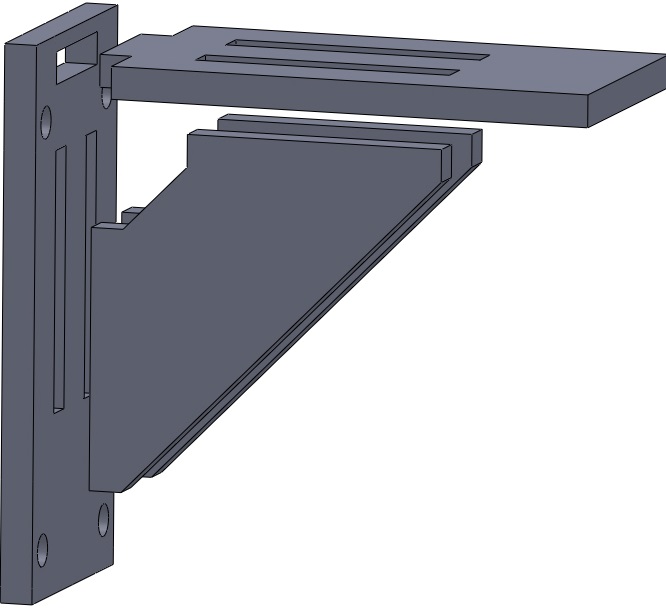
3D printing is inherently a slow process. This becomes obvious if you try to print a big part. If you are trying to make a large part and you want it quickly, then you might want to consider exploring laser (or waterjet) cutting instead. Let me try compare laser cutting with 3D printing with the example of a support bracket shown in Figure 1. 
Figure 1: Concept of a bracket

Figure 2 shows a 3D model of this bracket that you can make on a 3D printer. It will take several hours of printing time on a fused deposition modeling machine. You will also need to wait for many more hours for the support material to dissolve. Therefore, you will have to wait for an entire working day before you can get your bracket and start using it. 

Figure 2: Bracket design that can be made on 3D printer
Laser cutting is a fast process that requires no setup time. Unfortunately, fast speeds in laser cutting are only available if you are cutting two dimensional profiles. You can cut pockets using raster cuts, but then the laser cutting process tends to be slow. For the bracket shown in Figure 1, you can simply design it to be a four piece assembly (shown in Figure 3). Each of the four individual parts can be simply cut as a 2D profile on a laser cutter in a few minutes. 
Figure 3: Bracket design as a four part assembly; each part can be cut on a laser cutter.
If you can design the desired shape such that it can be assembled from parts produced by laser cutting two dimensional profiles, then you can realize your parts at a low cost and get them in a matter of minutes. You will be surprised by what can be realized by this simple process. For example, we have made several versions of legged robots using this process. 

If you really need to make integrated 3D parts and it is not possible for you to convert your 3D model into an assembly of 2D parts, then you should go for 3D printing. For example, to build a robotic bird we decided to use 3D printing to make structural parts. Assembling a structural frame from small laser cut parts would have been simply impossible in this case, so 3D printing was the right choice in this case. 

3D Printing or Laser Cutting? The answer to this question depends upon the part. 3D printing is a great process and the right answer in many cases. Laser cutting is process with remarkable capabilities, and you should think about it as an alternative to 3D printing. Laser cutting tends to be a lot faster and cheaper than 3D printing, but making it work requires creativity during design.